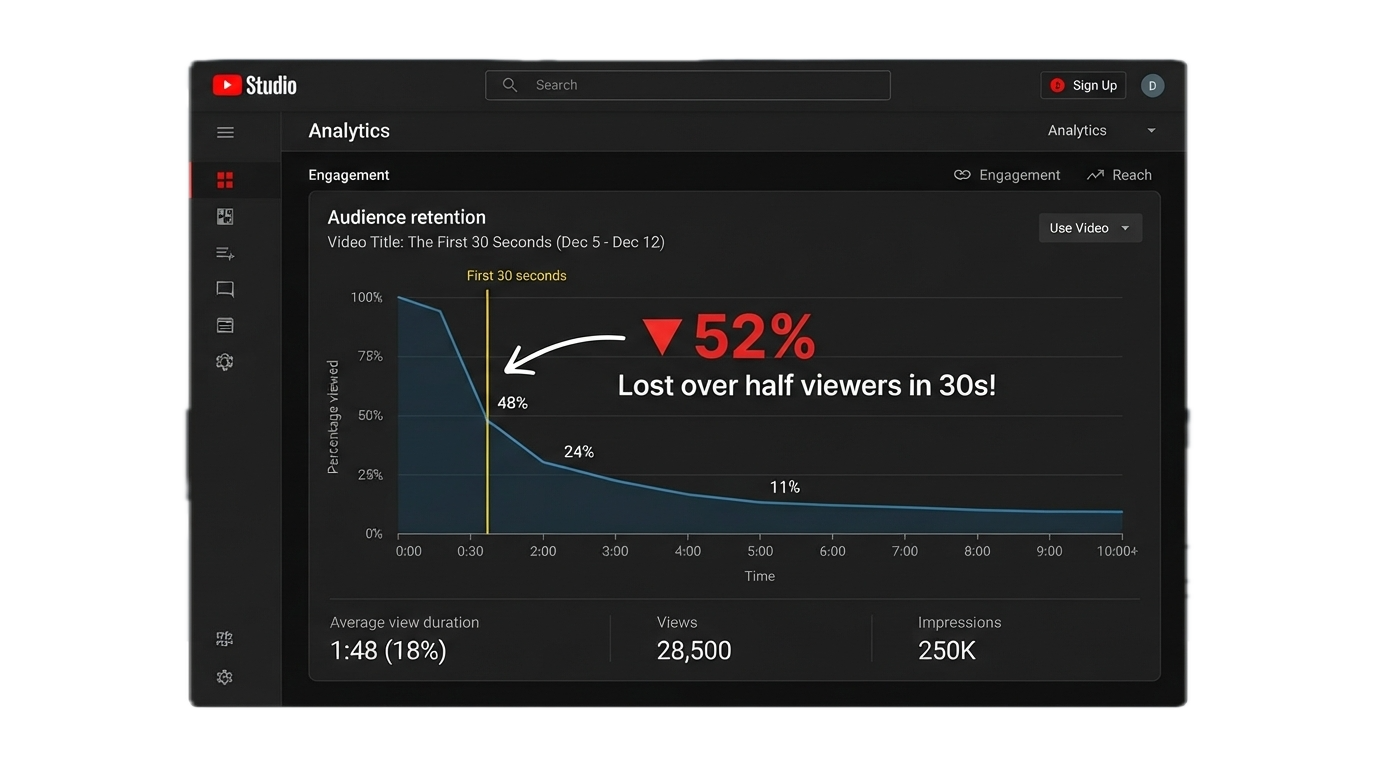
The title earned the click. Now you have about thirty seconds before the viewer decides whether they made a mistake.
This window is where small channels bleed. Not because the content is bad — because the opening answers a different question than the one the click asked. Someone clicked to learn the thing the title promised, and instead they got a logo, a "hey guys," and a roadmap of what's coming. They leave, and the retention graph records it as a verdict on the whole video.
Here is how to build an opening that keeps the click.
What the first 30 seconds actually have to do
Every good opening does three jobs, usually in this order:
- Confirm the promise. Show or state, immediately, the thing the title and thumbnail sold. Not a hint of it later — proof of it now.
- Establish the stakes. Make clear why this matters to the viewer. What changes for them if they keep watching? What do they lose if they leave?
- Open one loop. Give a specific question you will answer, so there is a reason to stay past the setup.
If your opening does all three, the viewer has a reason to stay that is not "I like this creator." That last one is the only reason small channels cannot rely on.
A structure that works
You do not need a formula for every video, but a reliable default helps when you are starting.
0 to 5 seconds — pattern interrupt. Start with the most interesting frame, claim, result, or question you have. Not a greeting. Not an intro animation. The single most compelling moment, moved to the front. If your video has a dramatic result, open on it and then rewind.
5 to 15 seconds — the payoff promise. Say plainly what the viewer will get and why it is worth their time. This is where you re-state the promise in a way that feels like a payoff, not a table of contents. "By the end of this, you'll be able to X" is weak if it is generic; strong if it is specific to the exact problem they clicked about.
15 to 30 seconds — commitment and stakes. Raise the specific question or tension that carries the video. This is your open loop. "The strange part is that it only works if you do the opposite of what everyone recommends — I'll show you what I mean." Now the viewer has a reason to stay past the setup.
Openings that quietly kill retention
Scan your last few videos for these. Each one is a leak:
- The logo or animated intro. Nobody clicked a title to watch a bumper.
- "Hey guys, welcome back to the channel." Fine among fans, poison with strangers. Save it for after the payoff, or cut it.
- Channel housekeeping. "Quick reminder to like and subscribe, and check out my last video." You are asking for payment before delivering the goods. Move every ask after the value.
- Long personal backstory. Context matters, but only once the viewer cares. Lead with the point, then fill in the background.
- Burying the payoff. If your most compelling argument or result arrives at minute four, you have it backwards. The reveal belongs at the front or as a tease.
- Tone mismatch. A comedy intro on a serious essay (or the reverse) tells the audience they are in the wrong place. Pick one voice.
- A roadmap of everything you will cover. Listing five sections sounds organized and feels like homework. Tease one loop, not five.
Before and after
Here is what this looks like in practice.
Before: "Hey everyone, welcome back! Today I'm going to talk about budgeting, and I've got five tips. But first, quick reminder to subscribe and check out last week's video. So, tip number one..."
After: "If your paycheck disappears in the first week, the problem usually isn't your income. It's one category of spending you've never actually measured. I did this for 30 days and it cut $400. Here's the exact method, and the mistake I made on day three."
Same topic. The second one confirms the promise, stakes the pain, and opens a loop — all before the viewer can get bored.
Before: "In this tutorial, I'll show you how to set up your camera for streaming. Let's start with the gear you'll need."
After: "This is the exact camera setup I use to stream, and it costs less than a used phone. You need three things, and the third one is the reason most people's streams look bad."
How to check your own openings
You do not have to guess where you lose people. In YouTube Studio, open the video, go to Analytics → Engagement → Audience retention, and look at the shape of the first minute.
- A cliff in the first 30 seconds means your opening failed the promise. This is the most fixable problem you have.
- A gradual decline after a steady start means the content or pacing is the issue, not the hook.
- A flat, high line means the opening worked and you should protect whatever you did.
Watch from the moment just before the biggest drop and ask what changed: the promise, the pace, the tone, or an interruption. The graph tells you where; the footage tells you why.
The mindset shift
Treat the first 30 seconds as the most expensive real estate in the video. Every second you spend on a greeting, a subscribe ask, or a slow setup is a second you borrowed from the payoff the viewer clicked for.
Earn the attention first. Then ask for the like, the subscribe, and the rest. The creators who grow fastest open with value and close with the ask — not the other way around.
What Edison does
The research from this guide, automated on your channel.
Competitor breakdown
Finds the fastest-growing channels in your exact niche and maps what they're doing structurally — hook length, video format, thumbnail patterns, topics.
Retention drop detection
Pinpoints the exact second viewers leave your videos and tells you what caused it, so you can fix the structure instead of guessing.
Thumbnail benchmarking
Compares your thumbnails against the top-performing videos for your keywords and tells you whether a stranger would click yours at scroll speed.
Most channels that do this research manually spend 4–6 hours per video. Edison runs it in minutes.
Edison maps your opening against the title and thumbnail promise, finds the exact second your hook breaks, and shows you the pacing that holds viewers in your niche.
Related Breakdown & Guides

Your YouTube Channel Isn't Growing - And It's Not the Algorithm
Wondering why your YouTube channel is not growing despite posting consistently? The issue isn't the algorithm—it's format mismatch. Learn how to fix it.

How the YouTube Algorithm Works for Small Channels (What Actually Decides Your Reach)
Subscriber count does not gate your reach. Here is how YouTube actually decides whether to show a small channel's video — targeting, the seed test, CTR, and watch time — and how to find which stage is capping you.

How to Get Your First 1,000 Subscribers (Without Going Viral)
A realistic, no-virality strategy for a new channel to earn its first 1,000 subscribers through search-led content, one consistent format, and turning viewers into subscribers.
3-day trial · $17 today· cancel anytime
See exactly where your viewers leave
Edison reads your retention graph frame by frame and compares your opening to the fastest-growing channels in your niche, so you know the exact second your hook breaks.
- A full analysis of one of your videos — or a competitor’s
- Packaging, topic, and retention diagnostics
- Specific changes to make before your next upload
After your trial, plans start at $49/month
Cancel anytime · secured by Paddle