
A thousand subscribers is not a vanity number. It is the point where your channel starts to have a real audience — enough people who return that YouTube begins treating your uploads differently. And you do not need a viral video to get there.
The channels that reach 1,000 subs fastest are usually not the most talented or the most produced. They are the most focused. They pick a lane, solve a specific problem for a specific viewer, and make it obvious why that viewer should come back. Here is how to do it on purpose.
First, the math that should calm you down
At a typical early conversion rate, somewhere between 1% and 4% of viewers subscribe to a video that lands well. That means 1,000 subscribers does not require a million views. It requires something like 40,000 to 100,000 well-targeted views spread across a body of work — a few hundred views per video over 40 or 50 videos, with each one earning its share.
That is achievable without a single viral moment. (For the full timeline math — how many uploads, how many views — see how long it takes to monetize a channel.) What kills most new channels is not lack of views; it is that the views do not compound, because every video targets a different viewer.
Lever 1: Build on search-first topics
The fastest, most durable path to a first audience is content people are already searching for. A tutorial that answers "how to edit a video on iPhone for free" will keep collecting views for months, long after a trend video stops. Those accumulated views keep converting new subscribers while you sleep.
Publish your first several videos as searchable answers to specific questions in your niche. Each one should be narrow enough that the person searching knows instantly it is for them.
Lever 2: One lane, no wandering
YouTube recommends videos to viewers based on patterns. If your channel makes videos about Notion, gaming, and cooking, the system cannot build a reliable profile of who your audience is, so your next upload starts with a tiny, vague test audience.
Pick one lane and stay in it long enough for a pattern to form. A channel that uploads ten videos about the same tool or topic gets niche-clustered; the algorithm knows exactly who to show video eleven to, and those viewers convert at a higher rate because they recognize the channel as the place for that subject.
This is the single hardest discipline for new creators, and the single biggest reason channels stall.
Lever 3: Make the packaging a promise, not a description
Subscribers come from viewers who click and stay. If your title is an accurate description of the video, it is not doing its job. "My camping trip" is a description. "I camped for a week with the cheapest gear I could find" is a promise — a specific person wants to know how it went.
Front-load the promise in the first 50 characters, because that is all most mobile viewers see. And make sure your thumbnail and title tell the same story. When they conflict, viewers hesitate, and hesitation is a lost subscriber.
Lever 4: Earn the subscribe, then ask
Most channels either never ask, or ask too soon. Both leak subscribers.
The pattern that works is simple: deliver, then invite. Right after you have given the viewer the payoff they clicked for, tell them what staying gets them. Not "please subscribe" in the abstract — a reason. "If you want the follow-up where I test this on a full trip, subscribe and it'll show up in your feed." That converts a specific, interested viewer into a specific, interested subscriber.
Three places to make the ask work for you:
- A series. If your videos come in a recognizable set — Week 1, Week 2, or Part 1 and 2 — viewers subscribe to avoid missing the next one.
- End screens. Point viewers to the single best next video in your lane. A relevant next watch is what turns a one-time viewer into a fan.
- A pinned comment. Answer the most common follow-up question and link the video that goes deeper. It keeps the interested viewer inside your channel.
Lever 5: Watch returning viewers, not just new ones
One metric separates growing channels from stuck ones early on: returning viewers. If the same people come back for your next upload, your audience is real and YouTube responds by testing your videos with slightly larger audiences.
Two things build returning viewers:
- Format consistency. Viewers should know what they are getting. Same structure, same promise, same lane.
- A reason to return. Ongoing series, a project with updates, or a clear answer to "what do I get next time."
The 90-day plan
Days 1 to 30 — foundation. Pick one narrow lane. Publish three search-optimized videos answering specific questions. Set up your channel page so a first-time visitor instantly understands what the channel is about.
Days 31 to 60 — learn from data. Pull the retention graph from each of your first three videos. Find the biggest drop and figure out why. Publish four or five more videos applying what you learned, staying in the lane.
Days 61 to 90 — double down. Identify which topic earned the most watch time per view and the most subscribers. Make more of that. Start linking videos into a series so a viewer of one has a reason to watch two.
What not to do
- Do not buy subscribers. They do not watch, and they can block monetization.
- Do not do sub-for-sub. You will collect an audience with no interest in your content, and your metrics will reflect it.
- Do not change topics every video. It resets the audience profile you are trying to build.
- Do not wait for viral. A body of consistent, searchable work beats a lottery ticket.
A thousand subscribers is a compounding problem, not a viral one. Pick your lane, answer real questions, deliver before you ask, and give viewers a reason to come back. Do that for long enough and the number takes care of itself.
What Edison does
The research from this guide, automated on your channel.
Competitor breakdown
Finds the fastest-growing channels in your exact niche and maps what they're doing structurally — hook length, video format, thumbnail patterns, topics.
Retention drop detection
Pinpoints the exact second viewers leave your videos and tells you what caused it, so you can fix the structure instead of guessing.
Thumbnail benchmarking
Compares your thumbnails against the top-performing videos for your keywords and tells you whether a stranger would click yours at scroll speed.
Most channels that do this research manually spend 4–6 hours per video. Edison runs it in minutes.
Edison finds the videos in your niche that convert viewers into subscribers, then shows you where your channel is losing those viewers before the subscribe ever happens.
Related Breakdown & Guides

One of My YouTube Videos Blew Up. Now Nothing Else Gets Views. Here's Why.
You had one video take off—and now every video after it gets ignored. This isn't bad luck. It's a specific structural problem, and there's a method to fix it.
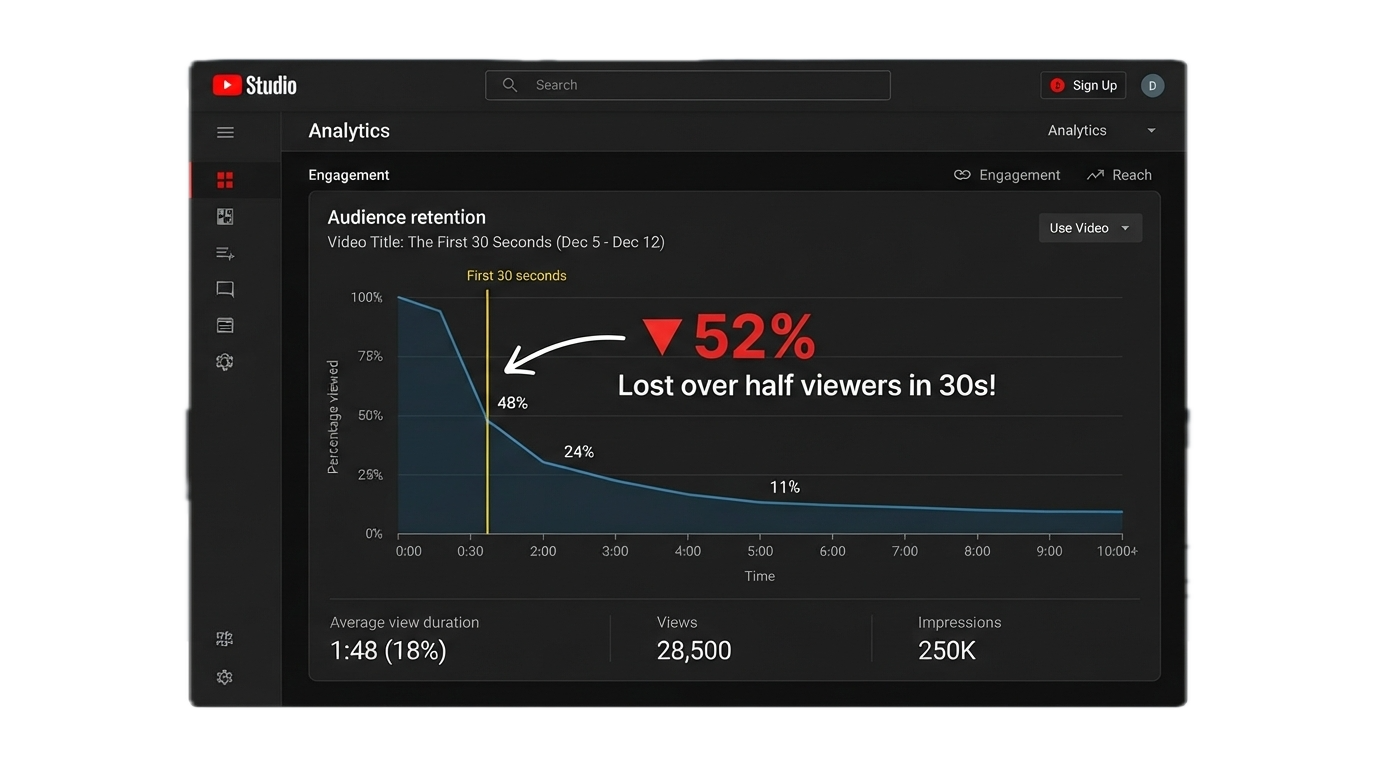
The First 30 Seconds: How to Stop Losing Half Your Viewers
Most viewers decide whether to stay within 30 seconds. Here is a practical structure for the opening of a YouTube video, the patterns that burn retention, and before/after rewrites you can steal.

My YouTube Retention Is 60% But I'm Still Getting No Views (Here's Why)
Good audience retention but zero views is one of the most confusing situations a new creator faces. The problem isn't your video—it's the metric you're ignoring. Here's exactly what's happening.
3-day trial · $17 today· cancel anytime
Turn views into subscribers
Edison shows you the exact videos in your niche that convert viewers into subscribers, and where your channel is leaking them before the subscribe happens.
- A full analysis of one of your videos — or a competitor’s
- Packaging, topic, and retention diagnostics
- Specific changes to make before your next upload
After your trial, plans start at $49/month
Cancel anytime · secured by Paddle